In the world of life safety, there is a fundamental distinction between the systems that "act" and the systems that "are." While the roar of a fire alarm and the sudden activation of a sprinkler system are the most visible signs of fire defense, there is a quieter, more steadfast guardian built into the very bones of our modern infrastructure.1 These are the Silent Sentinels: Passive Fire Protection (PFP).
The Philosophy of Containment
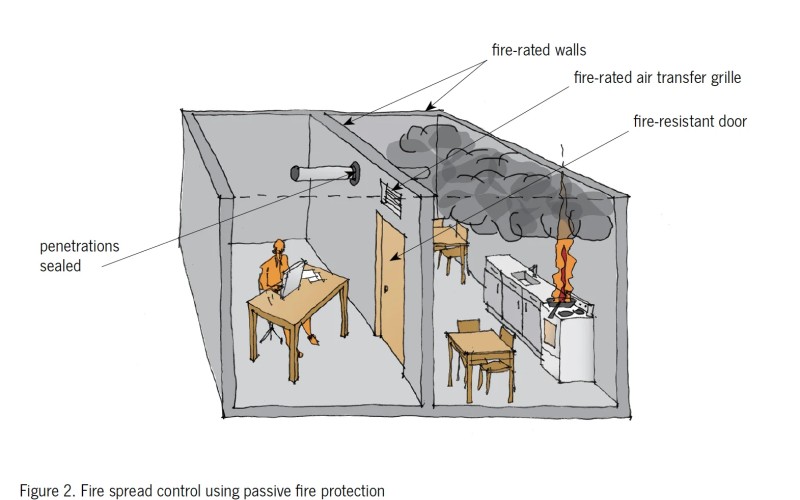
The core philosophy of Passive Fire Protection is compartmentation. Imagine a large office building or a high-rise apartment complex as a single, open vessel. If a fire starts in the basement, heat and toxic smoke would naturally rise through elevator shafts, stairwells, and utility gaps, engulfing the entire structure in minutes.
PFP turns that "vessel" into a series of independent, fire-resistant boxes. By using fire-rated walls, floors, and ceilings, PFP ensures that a fire starting in Room A is physically trapped there.2 This "boxing in" of the fire serves three critical purposes:
-
Life Safety: It protects escape routes (corridors and stairs), giving occupants a smoke-free path to exit.3
-
Structural Integrity: It prevents the building’s steel or concrete skeleton from reaching temperatures where it would lose strength and collapse.4
-
Property Protection: It limits the damage to a specific zone, allowing firefighters to tackle a localized blaze rather than a building-wide inferno.5
The Layers of the Shield
Passive Fire Protection is not a single product, but a multi-layered strategy involving various specialized materials:6
1. Structural Fireproofing
Steel is strong, but it is vulnerable to heat.7 At approximately $550°C$ ($1022°F$), structural steel loses about 50% of its load-bearing capacity. To prevent a catastrophic collapse, PFP utilizes:
-
Intumescent Coatings: These look like standard paint but undergo a chemical expansion when exposed to heat, swelling into a thick, carbonaceous "char" that insulates the steel.8
-
Endothermic Wraps: Materials that release chemically bound water when heated, actively cooling the surface they protect.9
2. Fire-Stopping and Penetration Seals
Modern buildings are "living" organisms with miles of electrical wires, plumbing pipes, and HVAC ducts running through walls. Every time a plumber or electrician drills a hole through a fire-rated wall, they create a "highway" for fire and smoke.
Fire-stopping involves filling these gaps with specialized intumescent caulks, pillows, or collars.10 These materials are designed to expand and seal the hole completely, even if the pipe passing through it melts away.11
3. Fire-Rated Glazing and Doors
Windows and doors are traditionally the weakest points in a fire barrier.12 PFP utilizes fire-rated glass—which can withstand thermal shock without shattering—and heavy-duty fire doors equipped with intumescent strips. These strips expand to seal the gap between the door and the frame, preventing the "chimney effect" where smoke is sucked under the door.13
The Invisible Benefit: Buying Time
The most precious commodity in a fire is time. Most PFP components are rated by time: 30, 60, 90, or 120 minutes. This rating tells architects and fire marshals exactly how long that barrier will stand up to a fully developed fire.
This time allows for the "Defend in Place" strategy, which is essential for hospitals or care homes where patients cannot be easily moved.14 In these scenarios, the PFP creates a "Refuge Area" where patients stay safe while the fire is fought in another wing.
The Challenge: Human Intervention
The greatest threat to these "Silent Sentinels" is human error. Because PFP is passive and often hidden behind drywall or above ceiling tiles, it is frequently compromised during building renovations. A single unsealed cable tray or a fire door propped open with a wooden wedge can render a million-dollar PFP system useless.
True fire safety requires a marriage of Active Systems (which detect and suppress) and Passive Systems (which contain and support).15 Without PFP, a sprinkler system might be overwhelmed by a fire that spreads too fast. With PFP, the fire is held at bay, the structure remains sound, and every occupant has the time they need to reach safety.16
Visualizing the System
To help you visualize this, I can generate an image of a "Fire-Stop Penetration" showing how specialized materials protect a wall where pipes pass through, or a diagram of Building Compartmentation.