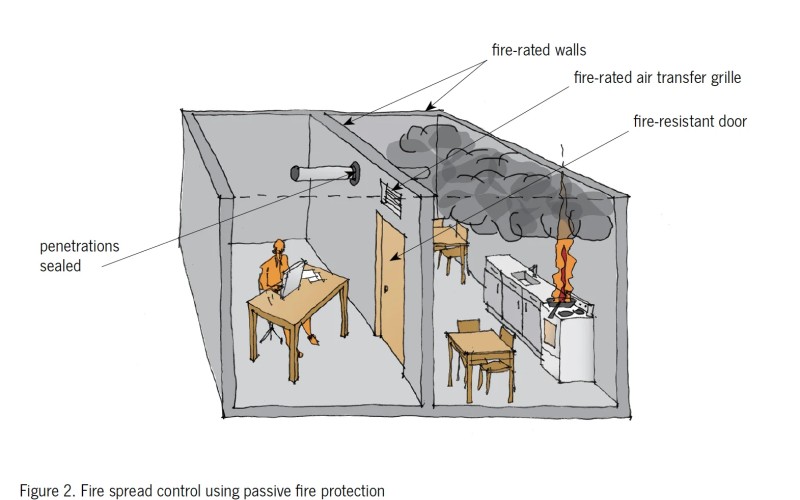
Passive fire protection systems use structural and material elements integrated into a building to limit the spread of fire and smoke. They rely on the building's design and construction, rather than requiring activation or human intervention, to contain fire and smoke. Examples include Fire Stopping Boards, Intumescent fire collars, fire doors and fire mastic.
Passive fire protection, also sometimes defined as 'built-in' fire protection are those components materials and systems that go to make up or sit within the fabric of a building.
Many construction materials such as building bricks, whilst not specifically specified to understand a fire protective role, have some natural resistance to fire and as such offer a measure of 'fire resistance' as part of a buildings built-in fire protection.
However, such natural fire resistance may be enhanced by way of additional materials or components that are known by the collective term Passive Fire Protection. In the main such protection measures are called passive because they do not need any special energisation or command signal to operate, (although some systems such as fire curtains, fire/smoke dampers and certain types of doors may be designed to operate from such methods).
Passive fire protection is a general term that covers a wide range of generically different system, which includes:
- Fire protection to the structural frame of the building.
- Internal compartmentation and fire resisting construction.
- Building services
- The building envelope
The Primary Function of Passive Fire Protection
The primary function of passive fire protection is to control the spread of fire and smoke within a given fire compartment for a prescribed period of time, which might generally range from between thirty minutes and four hours.
In case of a compartment wall or ceiling, this fire rating will not only apply to the compartment itself, but also to any service that might pass through the compartment, horizontally or vertically, as well as any opening, such as doors, windows or hatchways.
The term passive fire protection also covers materials such as paints, coatings, varnishes and surface impregnations intended to improve or maintain a building's 'reaction to fire' performance i.e. those characteristics that improve the reaction to fire performance of wall and ceiling linings.